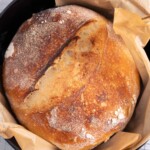
Easy Sourdough Bread
Learn how to make the easiest sourdough bread with a simple no-knead method and overnight rise. You'll get a crisp crust, soft interior, and bakery-quality flavor every time!
Servings: 1 loaf
Equipment
- Dutch oven (optional but recommended!)
Ingredients
- 150 grams active, bubbly sourdough starter at peak rise
- 330 grams water
- 10 grams salt
- 500 grams bread flour
Instructions
- [Day 1] Mix the dough. Stir together 150 grams sourdough starter, 330 grams water, and 10 grams salt in a large bowl. Add 500 grams bread flour and mix until it starts to form a shaggy mass. Cover the bowl with plastic wrap or a clean kitchen towel and let it rest for at least 30 minutes.
- Stretch and fold. Pull dough from one side and give it a long stretch, then fold dough back to the middle. Turn bowl a quarter turn, stretch again and fold back to the middle. Repeat on all four sides, cover the dough back up, and allow it to rest again.
- Repeat. Over the next few hours, you’ll repeat this process of stretching and folding the dough about every 30-45 minutes or so (exact time doesn't matter). Plan to stretch and fold a total of 4-5 times, or until dough feels hydrated, smooth, strong, and elastic.
- Shape. Line a large bowl with a tea towel and dust it lightly with flour (or use a banneton basket). Scrape dough out of its bowl onto a clean countertop. Shape dough into a rough ball, pulling it towards you to create tension. Flip dough over, placing seam side up in the towel-lined bowl. Cover with a kitchen towel or plastic wrap and allow dough to continue fermentation at room temperature until puffy and aerated and risen by 30-50%. This can take anywhere from 1-4 hours*.
- Cold ferment. After the fermentation period, place it in the refrigerator to continue fermenting overnight.**
- [Day 2] Score. Preheat oven to 450° F. Carefully tip dough out onto a sheet pan lined with parchment, seam side down. Remove towel. Score dough with a bread lame or very sharp knife in any desired pattern.
- Bake. Lift parchment paper with sourdough, lowering it carefully into Dutch oven. Bake with lid on for 25 minutes. Remove lid and continue to bake, uncovered, for another 18-25 minutes, or until bread is golden and cooked through and internal temperature is 205 – 215° F.
- Cool. Let bread cool at least an hour before slicing into it.
Notes
* Fermentation time can vary based on your starter and room temperature. I like to use the fingertip test to decide if my bread is proofed properly and ready to bake: Gently press the dough with a wet or floured fingertip (so it doesn't stick). If the dough springs back slowly and leaves a slight indentation, it’s ready to bake. If it bounces back immediately, it needs a little more time to rise; if it collapses or stays fully indented, it may be slightly over-proofed.
** It's optional to let the dough ferment overnight. You could also choose to bake it the same day. After doing the last stretch and fold, let the dough rest for 30 minutes. Then shape it, place it in a bowl lined with a flour-dusted towel, and let it rise and ferment another hour or two. Bake as directed.
If your sourdough starter seems weak or your loaves turn out squatty or don't rise well, give your starter some extra love. Feeding it a higher ratio of new "food" will help activate a weakened starter. I like to feed mine a ratio of 1:2:2 (starter: water: flour) or higher, even up to 1:5:5 to really get it going.
Trust me, this is the best thing you can do to revive your loaves!